Introduction
The idea here is to see the different components that make up the device, to understand what they are intended for, how they work independently, and also how they interact with each other.
The animation below shows the operation of the pump that will be studied in step 2.
Video Overview
-
-
-
When the Start button is pressed (rep 1), a circuit is closed which powers, via a relay (rep 2), the heating resistance placed in the sole or plate of the iron (rep 6). When the temperature is reached, a beep sounds (after about 2 min).
-
After the beep, steam can be produced by pressing the button in the iron's handle (rep 5). Thus, a circuit is closed which turns on a pump placed in the base, beneath the water tank (rep 3). This pump, placed between the water tank (rep 4) and the iron, makes water flow from one to the other.
-
The water, reaching the iron's sole through flexible tubing, turns to steam on contact with the heating resistance. Indeed, under the effect of the heat (approx. 130 °C-160 °C), the water turns to steam which escapes through the holes in the sole. Releasing the button stops the pump as well as the flow of steam.
 Ask FixBot
-
-
-
The device is composed of several subassemblies that we will look at seperately. We begin with the water pump.
-
This type of pump, called a suction pump, is common in devices requiring pressurization of a liquid, usually water. We can therefore find them in espresso coffee makers (pressurized hot water for percolation) and in iron steam generators.
-
The axial movement of a metallic piston (Ref. A), open at both ends so as to allow the flow of water, creates the pressure in the system. The back-and-forth movement is ensured by a magnetic field produced by a coil. You can see these parts by following the link at the end of this step.
-
The coil, equipped with a diode in series with its winding, allows for power via a single-phase half-wave rectified voltage. Put simply, the piston follows the electrical power frequency (50 Hz) and oscillates with 25 forward and 25 backward movements per second.
-
This pronounced vibration is the source of the very characteristc sound of a functioning pump.
-
Water enters one side of the pump (yellow arrow in the schematics). It passes through the cylinder (Ref. A) and arrives in the pale pink chamber. This chamber is alternately closed by two valves, pink (Ref. B) and blue (Ref. C). The pink one allows water to enter the chamber when the piston is released, the blue one being closed.
-
When the piston is activated, the pink one closes, the chamber is pressurized, forcing the blue valve to open and let the water through. This cycle repeats 25 times per second.
-
-
-
-
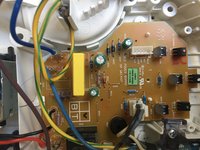
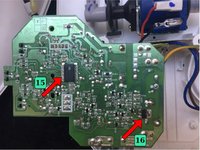
The device has a printed circuit board (PCB) in the base of the tank. The operation of the device is entrusted to a microcontroller unit (rep15)(PIC16F1820). This manages the inputs-outputs of the device connected to the various elements: probe, sensor, pump, control panel, in order to ensure proper heating of the iron and steam generation.
-
Iron sole-plate temperature management. Is carried out by means of a probe placed in contact with the sole-plate. This iron does not have a manual thermostat to adjust the temperature of the iron. The temp is fixed and is controlled by the probe (see next step rep8). The temp measured on the sole-plate of the iron is 160°.
-
Pump flow management using a thyristor (rep16) BT168 GW. This allows the volume of steam to be reduced in ECO mode or increased in TURBO mode and for the descaling function (see the tutorial for various functions, the device controls)
-
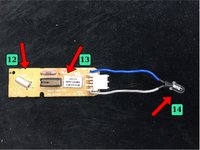
Iron tilt management. This iron has a tilt or motion sensor (rep12). It is a capsule containing a ball. When the iron is horizontal, the ball closes a contact: the resistance heats. When the iron is tilted (on its base, for example), the contact opens. The resistance is no longer powered.
-
Descaling management. By pressing the button provided for this purpose, the pump operates for 2 min without interruption with the maximum flow rate. The iron regularly signals the need to perform this operation. The microcontroller unit is therefore programmed to manage this alert and block the pump if the operation is not started.
-
Management of light and sound signals. 3 LED are placed on the printed circuit board opposite each button of the control panel as well as a buzzer. The signals emitted by these components are described in step 3 of the "different functions" tutorial. Another LED (rep14) is connected to a small PCB placed in the handle of the iron.
-
This small PCB also supports the steam switch (rep13) activated by the steam button (rep5) and the tilt sensor (rep12).
-
-
-
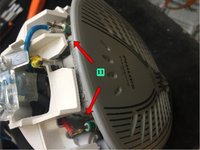
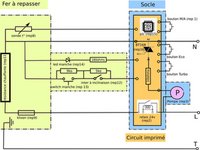
The electrical circuit is made up of a power cord with 3 conductors: Phase (brown), Neutral (blue), and Ground (green/yellow). These three wires are connected to the electronic board. The ground wire is connected to the iron through a protective sheath.
-
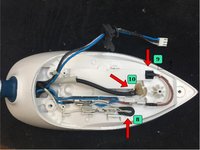
In this sheath are also the wires that will power the heating element (Ref. 11) via the Klixon protection (Ref. 9) and the temperature probe (Ref. 8) as well as the control wires (ON/OFF button, LED, etc.) which are in the handle of the iron. One also finds the umbilical tube through which water flows (Ref. 10).
-
The attached schematics shows the main components and their connections.
-
-
-
The hydraulic (water) system is as follows (red): the water is stored in the reservoir (rep4). When the user requests steam by pressing the button placed in the handle of the iron (rep5), the pump (rep3) is started. The water is then sucked up and sent through the tube (rep10) to the sole of the iron (rep6).
-
A safety bypass is located at the pump outlet (rep17). If the water cannot be ejected (clogged tube) it returns to the tank (green).
-
-





Now that we know the functionalities of our device and we know the sub-assemblies and the operation, we can move on to the repair phase with the following tutorial: "Steam iron, Step 3: common breakdowns" (Please note that this page is currently untranslated.)
Cancel: I did not complete this guide.
21 other people completed this guide.
Special thanks to these translators:
100%


These translators are helping us fix the world! Want to contribute?
Start translating ›

Team

6 Guide Comments
Thank you for this guide, identifying the components was helpful. If there are some links for troubleshooting the pump system you would recommend, I would appreciate it as well. Let's make things repairable :)
Thank you for this guide, identifying the components was helpful.
Same problem happened with me also. Pump of my iron is not working and it is very difficult to find the same in India. If there are some links for troubleshooting the pump system you would recommend, I would appreciate it as well. Let's make things repairable :)
Does your pump run when you press the calc button?
You shared very useful information, thank you very-very-very much!!!
