

We just tore down the two latest Apple Watches. And Apple, we need to have a talk.
Let’s cut to the chase: there’s no big repairability news here. The Series 12 got a battery pull tab, which, along with some other small architecture changes, brought it up by a point on our repairability scale. The Ultra 4 is essentially the same as its predecessors.
Apple Watch is falling behind the rest of Apple’s lineup when it comes to repair. We’ve seen big gains in iPhone repairability, thanks to screwed-in and electrically released batteries, plus dual entry in some models. Self-Service Repair is getting parts and tools directly to customers for iPhones, iPads, MacBooks, displays, and some audio products. Repair Assistant has solved some of the biggest problems of Apple’s software lock practice known as parts pairing. Meanwhile, the only repair channel available for the Apple Watch is to take it back to Apple.
It’s time to step up to the repairability plate, Apple Watch team.

We Believe Apple Watch Is Out of Compliance in Ten States
Ten states have passed electronics Right to Repair laws, covering more than a third of Americans. That is a lot of people with a legal right to keep their electronics working.
We believe Apple is denying them that right when it comes to Apple Watch and is out of compliance in all ten states. In Oregon, for instance, the law requires that for any digital electronic product for which the manufacturer provides repair services, they must make the same parts, tools, and documentation available to independent repair shops and DIY repairers. Every state has its own definitions and exclusions, but they all aim to support competition in the repair market by opening up access for independents and DIYers.

Apple offers its own Watch repair and battery services. That means Apple has parts, tools, and documentation available to their own technicians.
By law in the ten states that have passed electronics Right to Repair, we should be able to get those same materials. Yet Apple sells no Watch repair parts or dedicated service tools to DIY fixers and provides no corresponding repair manuals through its Self-Service Repair program. A repair option that ends at Apple’s door is exactly the problem Right to Repair is meant to solve.

Health Features Make Repair Access More Urgent
How is Apple getting away with not providing repair access? So far, most states haven’t challenged them publicly.
But in Minnesota, Apple told the Attorney General that they’re in full compliance with the law through Self-Service Repair. In the linked thread, someone identifying themselves as an Apple-Authorized Service Provider claims that the Apple Watch is a medical device and therefore should be exempt from the law. Apple’s own safety guidance, meanwhile, explicitly says the Watch is “not a medical device.” The FDA agrees with that safety guidance, calling the Watch a “general purpose computing platform” that runs the FDA-cleared hypertension notification feature. Which is it, Apple? Medical device or not?
Regardless, we reject using the Watch’s health features as a reason to shut owners out of repair. But let’s take those benefits seriously, because they are serious.
Our teardown lead, Shahram Mokhtari, uses a second-generation Apple Watch Ultra to help track his arrhythmia. He likes it. He also has a familiar problem: its battery no longer holds a charge like it used to, and he is understandably reluctant to pry up an expensive screen to replace it.

That is the contradiction sitting on our teardown table. The more someone relies on a watch’s health features, the more consequential an ordinary battery failure becomes. Those benefits should strengthen the case for an easier battery change, accessible parts, and clear instructions.
Imagine the battery giving out while you are traveling, far from an Apple Store. Mailing the watch away may be an option, but it still means time without the device. A nearby independent shop could help. An experienced owner who relies on the medical features of their device might want to carry a spare replacement battery and the tools to install it. Apple should help make that option practical.
Our teardowns of the Apple Watch Series 12 and Ultra 4 show that battery changes are absolutely possible, though there is still an expensive screen between you and the consumable battery. Let’s dig into those teardowns.
Ultra 4 Hit “Pause” on Repair Improvements
We put the Ultra 4 on the heat mat first.
The sensors have a new layout, featuring more LEDs with wider surface area. Compare with the sliders below: Apple Watch Ultra 3 on the left, Ultra 4 on the right.


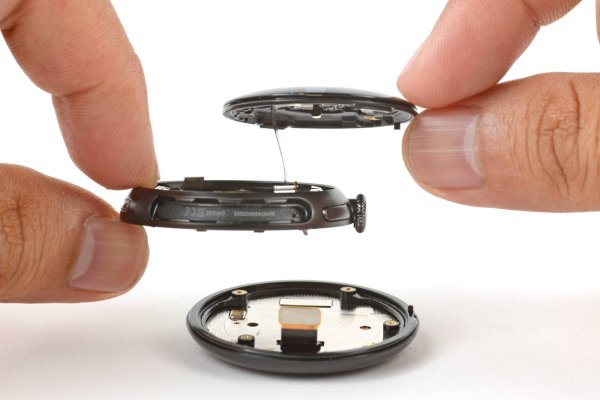
Don’t be fooled by those four pentalobe screws on the bottom. That’s not our path in. Taking those screws out will only give you access to the sensor assembly, and it’ll compromise your waterproofing.
To change the battery, or get to anything else inside the watch, we have to go through the screen.

After about ten minutes of heating, we lifted one edge of the display and cut through the perimeter adhesive. We’re debuting a brand new iFixit tool for just this problem: a thin metal opening pick with depth markings, which help us control how far the tool enters. That matters, with delicate cables waiting on the other side of the seam. (The metal opening pick will be available in our store soon.)
Once inside, we removed four screws and a bracket before disconnecting the battery. We found a slightly bigger battery: 2.444 Wh, compared with the Ultra 3’s 2.313 Wh.
Ultimately, the Ultra 4 earns a 4 out of 10 for repairability, the same score as the previous three generations. Four generations in, we’re still waiting for a meaningful change to this repair experience.

The Series 12 Finally Gave Us Something to Pull
We opened the Series 12 screen-first too, working with even tighter tolerances than the Ultra. We got the pick in, but the force required made us worry about the display.
Then we found a small win. With the battery connector bracket out of the way, we spotted a stretch-release adhesive tab. Instead of having to lever the battery out with a spudger, like in previous models, we were able to pull the adhesive free to release the battery. The Series 12 battery is rated at 1.461 Wh, up from 1.403 Wh in the 46 mm Series 11. Modest gains, but the pull tab is a real improvement.

We also found a simpler display connection: Apple eliminated the previous fiddly ZIF connector and its tape, in favor of a press connector under a bracket. There’s a tradeoff, though, because replacing the screen now requires removing and replacing the battery too.
The Series 12 and Ultra 4 both feature the new S11 SiP (System in Package), which has a CPU architecture based on the A20 Pro. See how much compute is packed into this tiny space for yourself, in this CT scan courtesy our beloved Lumafield Neptune scanner:
The battery pull tab and cleaner cable arrangement led us to give the Series 12 a 4 out of 10 repairability score, same as the Ultra 4, but up a point from the last time we scored the base model Apple Watch.
Google Shows That a Better Way Is Possible
Apple can’t credibly claim that the presence of the health features makes it impossible to provide repair parts or documentation. Google has proven that these features can be paired with great documentation, widely available parts, and repair-friendly design.
The Pixel Watch also offers heart-rhythm features, including ECG-based checks for signs of atrial fibrillation. The Pixel Watch 5 earned 9 out of 10 on our repairability scorecard, featuring just two Torx screws and a gasket between you and display replacement. The battery comes out with just a few more screws.

The comparison exposes two separate obligations. Apple can design a Watch that is easier to open. It can also make the service parts, tools, and instructions available for the Watches it already sells.
It’s Time for the Apple Watch to Comply with Right to Repair
Right to Repair laws differ in their scope, effective dates, and exemptions. Nearly all of the laws that passed are enforced by each state’s Attorney General. We’re rallying evidence to help these Attorneys General see the problem: Apple shouldn’t reserve repair resources for itself while telling the people who bought the product to come back to Apple for every fix.
If Apple believes a Watch is important enough to help someone monitor their health, it should be important enough to keep working. Sell the batteries. Make the tools available. Publish the documentation. Give independent shops and owners a path to the same repairs Apple offers.
The Series 12’s pull tab proves Apple can make incremental improvements. The Ultra 4 proves it can also let years go by without addressing the central problem. People who depend on these watches deserve more than an incremental concession hidden behind a glued screen. They deserve access to repair.
Here’s how you can help: if you’re in a state with electronics Right to Repair and have an Apple Watch you want to fix, ask Apple for the parts, tools, and documentation you need. If they refuse and redirect you to official repair channels, take screenshots, and report to your state’s authorities. Shoot us an email about your experience, too, to help us keep getting the word out.
It’s about time the Apple Watch got the Right to Repair treatment.


0 Comments