Introduction
Our week of game console teardowns is coming to a close, and we have a super-extra-special teardown for today. We partnered with Engadget to bring you a glimpse of one of the most interesting game consoles ever.
Direct quote from the guys who created the teardown: "The Virtual Boy is bar none the coolest device we've ever taken apart." Everyone at the office agrees that it's an awesome console, so much so that there have been arguments over who's going to play it next.
Nintendo called the Virtual Boy a "32-bit, 3-D experience" that "eliminates all external stimuli, totally immersing players into their own private universe." Even so, TIME Magazine listed the Virtual Boy as one of the worst inventions of all time, and PC World called it one of "the ugliest products in tech history." Of course, neither Time nor PC World ever opened one, so what do they know?
Join us today as we delve into the mystery behind the Virtual Boy's controversial and short-lived existence.
What you need
-
-
The Virtual Boy was only available in North America for seven months -- from August 14, 1995 until March 2, 1996 -- with only 770,000 units sold. Compare that with the Nintendo 64, which sold 32.93 million units over its lifespan.
-
Tech Specs:
-
20 MHz, 32-bit RISC Processor
-
128 KB dual-port VRAM
-
384 x 224 pixel resolution
-
2-bit monochrome display (black and three shades of red)
-
16-bit stereo sound
-
-
-
The Virtual Boy probably doesn't deserve to be ranked as one of the ugliest pieces of machinery of all time, but it does bear a striking resemblance to certain sci-fi characters.
-
The Neoprene eyepiece completely encompassed the player's field of vision. This not only isolated the player from the rest of the world, but prevented anyone else from seeing what the player was doing.
-
If only the Virtual Boy could play "other" content...
-
Games such as Mario's Tennis support the use of the Extension port on the underside of the Virtual Boy. Regrettably, Nintendo never got around to releasing an appropriate cable.
-
-
-
There were only 22 games made for the Virtual Boy, and only 14 of those were released in North America. Top hits include: Mario's Tennis, Wario Land, 3D Tetris, and Teleroboxer.
-
In order to deliver a full range of motion in a virtual 3-D environment, a method of controlling motion in the z-axis was required. To overcome this hurdle, a second D-pad was added to the controller.
-
No, that is not an infared image of Wario. The Virtual Boy took full advantage of the three shades of red available to create on-screen images.
-
-
-
-
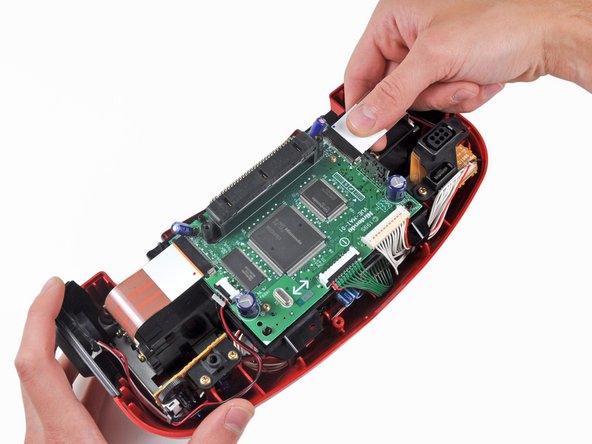
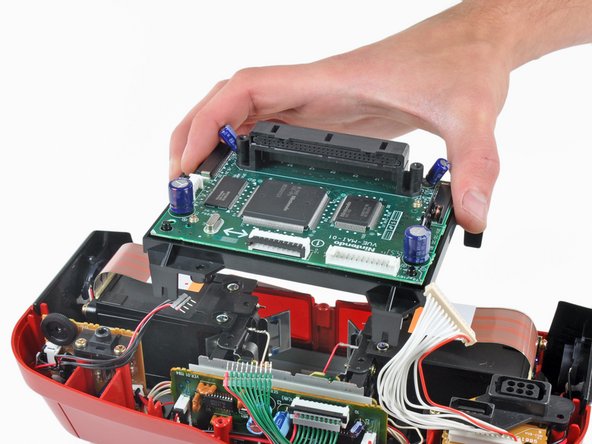
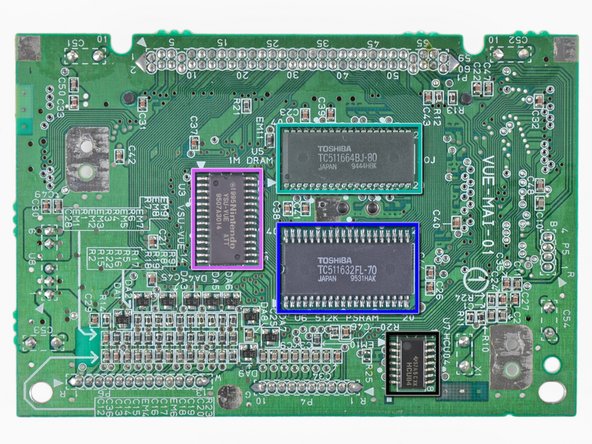
The main board is responsible for taking inputs from the controller, loading game cartridge data, sending audio data to the speaker amplifier, and driving the LED displays. The silk screened chips include:
-
Nintendo '95 VUE-VPU, 9520KK023
-
Nintendo NVC-VUE, (C) NEC '91 '93 9520KX003
-
Nintendo VRM-VUE, 9508KU028
-
Toshiba TC511664BJ-80 128 KB of DRAM
-
Toshiba TC511632FL-70
-
Nintendo '95 VSU-VUE ATT, 9507A3014
-
Texas Instruments 57A5CXK, HCU04
-
-
-
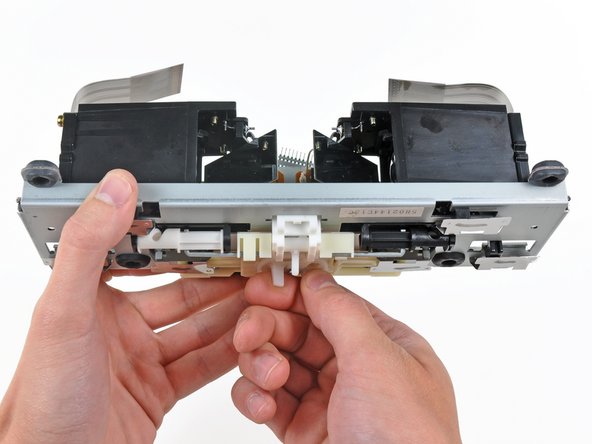
When the knob on the top of the Virtual Boy is rotated to adjust the inter-pupil distance (the center-to-center distance between pupils), the two display units move closer or further away from each other.
-
When the focus slider is slid back and forth, the lens in each display unit moves relative to the stationary LED display.
-
The Virtual Boy's 3D capabilities are a result of an effect known as parallax, in which a single image is viewed along different lines of sight.
-
This process is the basis for the method by which the human eye is capable of perceiving depth. Each eye receives a slightly different image (being a few inches apart and along different sightlines). The brain then interprets these two images into a single 3D image. This effect is called stereopsis.
-
The Virtual Boy uses each display to send a slightly different image to each eye, thereby creating a stereoscopic 3D image.
-
-
-
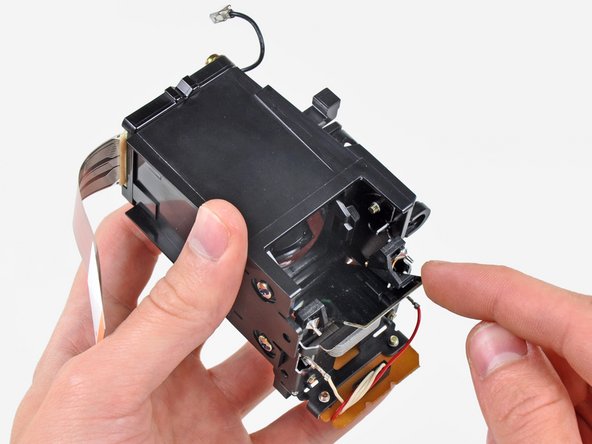
The Virtual Boy employs an extremely creative way of producing its unique binocular (and 3D) graphics.
-
A one-pixel-tall row of LEDs at the far end of each display unit projects light through a lens in the middle of each unit.
-
After passing through the lens, light is reflected off a mirror situated at 45o that oscillates about its central axis.
-
The mirror oscillates and the LED refreshes with such speed that the human eye perceives a single image across the view plane.
-
-
-
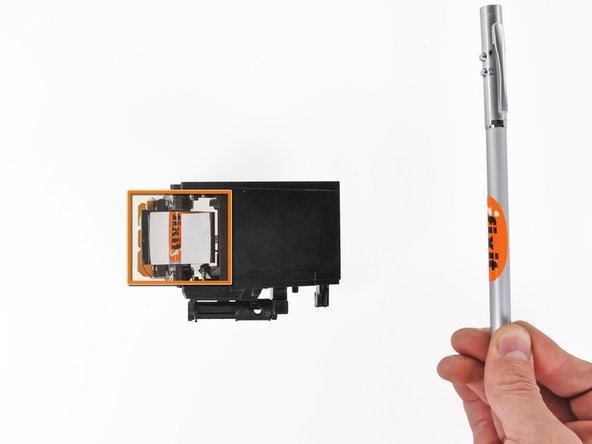
To oscillate the mirror, alternating electrical current at high frequency is passed through a copper coil attached to the mirror. A stationary iron core is attached to the display unit, forming a solenoid to produce the motive force needed for oscillation.
-
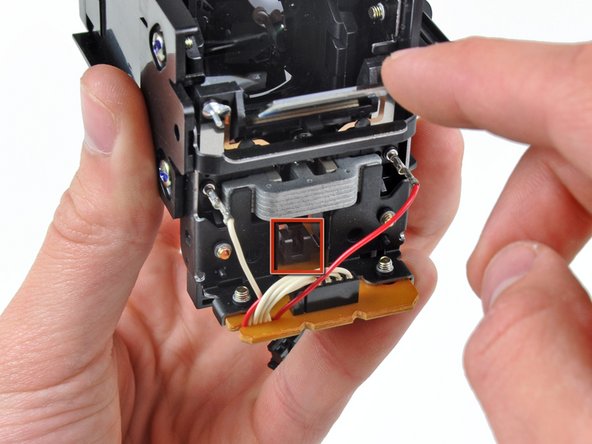
To tell the oscillator circuitry how fast the mirror is moving, an arm attached to the mirror passes back and forth through an optical sensor attached to the lower circuit board.
-
-
-
The board you see here is responsible for driving the oscillation of both mirrors.
-
The chips on this board receive display information from the main board and ensure that the mirrors are oscillating at the correct frequency by receiving feedback signals from the optical sensors shown in the previous step.
-
An 8 MHz crystal soldered to the board is used for timing the oscillation of the mirrors.
-
-
-
The Virtual Boy display! Each 4-color display unit was manufactured by Reflection Technology Inc., and featured a 1x224 pixel resolution with 32 levels of intensity.
-
Each "image" produced by the display is merely a row of red dots. Used in conjunction with an oscillating mirror, a full image is produced.
-
Because the entire image is produced by a single row of LEDs, the refresh rate is incredibly high. Each pattern of LEDs is displayed for only 0.000052 seconds!
-
LCDs were considered as an option for the display, however they could not refresh fast enough and caused blurry images. LEDs became the option of choice as they could refresh fast enough and were bright enough to create a steady, bright image.
-
The developers looked into using multiple colors in the display, but they were limited by price. Red LED's were chosen because they were the cheapest, most efficient, and most visible LEDs.
-
-
-
What a spectacular end to a week of retro: Magnavox Odyssey 100, RCA Studio II, Atari 2600, Famicom, and now the Virtual Boy. We hope you had fun -- we sure did!
-












3 Comments
A little disappointed that the teardown wasn't complete. You didn't teardown the controls! Maybe not as important as the displays, but still.
Dangerous and deadly if not looked well.
Just wondering but it looks like the bottom of your VB has stress factures around all the ports and screw posts? I seem to have them too and, like yours, they radiate outwards which leads me to think that they result from stress applied directly to the centre of the base of the unit.
