
 194
194  145
145  306
306 Stuck Throttle Cable
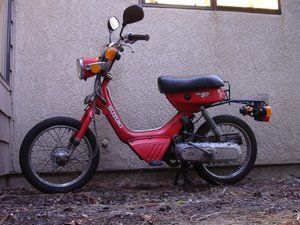
I have a 1984 Suzuki FA50 moped that ran fine until about six months ago. One day I tried to start it, and the throttle got stuck while trying to rev the engine. It would not budge from idle. I unstuck the throttle by twisting it as hard as I could (who says brute force doesn't work?). The throttle remained "unstuck," but the moped just wasn't the same -- it would immediately shut off as soon as I applied the throttle. I let it be and saved the repair for another day.
Fast-forward four months. I decided it would be a stellar idea to create a teardown for the moped, clean the carburetor, and figure out the throttle problem. I managed two of the three (teardown is almost done, and the carb is clean), but to this day I cannot figure out what the heck is wrong with the throttle. Since it's a pretty involved piece of machinery, I created another teardown that described the stuck cable problem in greater detail. Please take a look at it here:
Suzuki FA50 Moped Throttle Cable Teardown
I would love to hear any suggestions you have on how I can fix my Suzie's throttle. I miss riding it.
Update
I have since resolved the stuck throttle problem. After screwing with the throttle for hours, I figured out I've been inserting the cylinder off by 180 degrees.
I was actually about to order another throttle cable online, when I came across a schematic (which I already had in my manual). I glanced at it, and noticed the position of the cylinder in relation to the carburetor. What I found odd was that the notch (which I've seen dozens of times before) was 180 degrees rotated from how I was inserting it...
So I went outside, rotated the cylinder 180 degrees, and presto-blamo the entire cylinder assembly went into the carb about twice as deep as before!
What sucks is that I've tried the cylinder in that position before, but it didn't want to enter the carb in my previous try. I had actually rotated the cylinder multiple times, trying to insert it into the carb, and the only position that I thought worked was the one I was trying all along.
Finally after inserting it correctly, reassembling the throttle handle (I took it apart out of desperation), trying to get the thing started and fine-tuning it for three hours, I managed to go for a ride down the street!
...And then the weather turned inclement and poured rain for a week straight, rendering the moped useless for a while longer...
Is this a good question?