This translation was generated by a machine and has not been reviewed by a person yet. Speak this language? Review it.

General - Repairing Broken Parts

Rolf Jethon and one other contributor
Last updated on Sep 2, 2026
Views: 1K
View statistics:
- Past 24 Hours:
- 5
- Past 7 Days:
- 26
- Past 30 Days:
- 109
- All Time:
- 1,004
Comments: 0
No one has left comments on this guide. Will you be first?
Go to guide commentsCompleted: 0 1
No one has marked this guide "completed." Will you be the first?
1 person has marked this guide "completed." It's you — great job!
Favorites: 0 1
No one has favorited (and subscribed to) this guide. Will you be the first?
1 person has favorited (and subscribed to) this guide — and that's you!
Community-Contributed Guide
An awesome member of our community made this guide. It was not created by iFixit staff.
Introduction
Go to step 1 ↓In this guide, I will show how to repair broken plastic and metal parts so that they remain stable and durable.
Cyanoacrylate or superglue alone is usually insufficient for repairing broken parts. When the parts are under normal load, the bond often breaks quickly at the same spot.
The trick is to increase the bonding surface area using glass grit sprinkled onto the glue joint.
With this technique, broken parts often end up significantly more stable than they were before.
The video shows how this works:
What you need
Video Overview
-
-
-
You will need superglue and glass grit with a grain size of 0.05 to 0.5 mm.
-
Glass grit has the advantage of being alkaline, which causes the superglue to cure quickly.
 Ask FixBot
-
-
-
Locate the broken area and ensure it is free of dust, dirt, and grease.
-
-
-
Sprinkle glass grit onto the adhesive and wait for it to cure. If necessary, spray a little activator to accelerate the curing process.
-
-
-
-
Sprinkle more glass grit. Alternate applying glue, glass grit, and activator until the desired layer thickness is reached.
-
-
-
Once the desired layer thickness has been reached and cured, the part can be put under load.
-
-


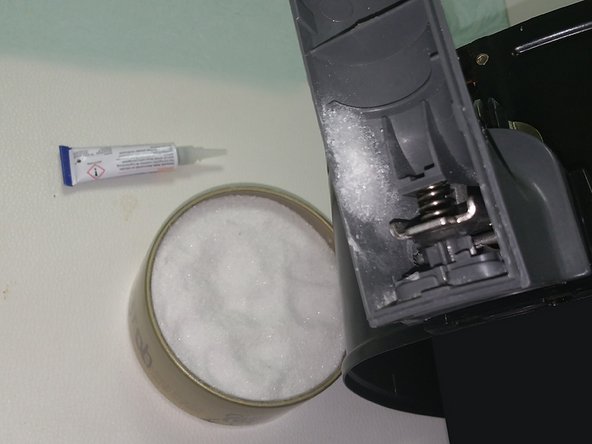


Low-viscosity superglue is better suited for this technique than gel-based glue, as the thin glue flows better into the capillaries between the glass grains.
Glass grit has the advantage of being alkaline, which causes superglue to cure quickly. In principle, you can apply as much glass grit as you like in layers, for example, to build up reinforcing ribs or bridges. Furthermore, holes and cracks can be filled in layer by layer in this way. Excess material can be trimmed off with a scalpel. Post-processing by filing or sanding is also possible.
The glass grit scattering technique is also well-suited for repairing porcelain and ceramic.
Unfortunately, not all plastics can be repaired this easily. In particular, polyethylene, polypropylene, and Teflon require a primer.

