Light Seals
|
1 Answer 1 Score |
How to Remove the Back Cover/Film Door? |
These are some common tools used to work on this device. You might not need every tool for every procedure.
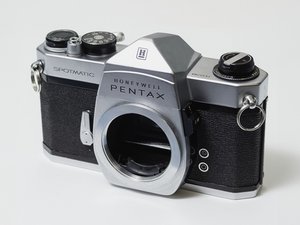
The Pentax Spotmatic was the first camera released by Asahi Optical Company with through-the-lens metering, a big advancement in camera technology for the era. The camera uses stop down metering, which means that the lens aperture needs to be closed down to the selected value for a meter reading to be taken and the proper exposure calculated. A switch on the side of the lens mount turns on the meter and stops down the aperture. Later cameras, like the Spotmatic F, were capable of open aperture metering when combined with Super-Multi-Coated Takumar lenses.


The Spotmatic was manufactured from 1964 to 1973 and saw many small modifications throughout that time. The guides found here were written for models with a part number of 23102, the most common version. Early Spotmatics, built between 1964 and 1965, have a part number of 231. The overall structure of the camera is the same but there may be differences in individual parts here and there. The guides are applicable to both Asahi Optical Company (AOC) Spotmatics and Honeywell Spotmatics. Other similar models such as the SP500, SP1000 and SP II can also be repaired with these guides, but some differences will need to be accounted for. Even the Pentax K1000 has the same basic architecture as the Spotmatic and can be repaired with some of the same guides. Electronic models like the Electro Spotmatic, ES, and ES II are fundamentally different cameras that require their own methods.
The operation of the camera, including the timing of the shutter speeds, is fully mechanical. The battery is only required for the light meter, but normal exposures can be made without any power. Consequently, most malfunctions are due to dirty or fouled mechanisms. Disassembling, cleaning and reassembling the affected area will resolve most issues with the camera. Occasionally, replacement parts will be needed, but the individual components are quite robust and most can be refurbished.
The general procedure for troubleshooting major faults and malfunctions is to disassemble the camera into its primary subassemblies and inspect each to see if it is functioning normally. For the Spotmatic, and most 35mm SLRs, the major subassemblies and the functions they perform are as follows.

The most common issue is simply a jammed camera. The shutter won't fire and/or the film advance won't wind. The release sequence of a mechanical camera is quite complex and if any latch or lever is not functioning properly, it can result in an incomplete exposure cycle and a jammed camera. The high level solution is to disassemble the camera and inspect the different mechanical subassemblies until the root cause is identified. The most common areas to find issues are on the bottom of the camera and on the side of the mirror box. Disassembling and cleaning the mechanisms can return most jammed cameras to functionality.
Inoperable meters are also common. This is usually caused by corroded battery contacts or bad internal wiring, which are repairable. Sometimes the light sensitive resistors (CdS cells) can fail, which requires a replacement part.
Exposure variation within the frame is another common problem. Over time, the speed of the shutter curtains can drift causing them to become out of sync. At high speeds, the curtains must be very precisely timed in order to create a narrow slit that travels over the film. If one curtain is too fast or too slow, the slit can collapse resulting in little or no exposure on that part of the frame. While the adjustment points for curtain speed and release timing are easily accessible, making changes is not recommended without advanced equipment that can accurately measure the speed and exposure time of the shutter. Additionally, extreme exposure variation is a sign of a dirty shutter and it's best to disassemble and clean it before making adjustments to ensure good long term performance of the camera.
If you are already performing significant disassembly of the camera for a repair, consider doing a more complete overhaul of the camera to reduce the chance of future issues. The following service will address the most common failure points of the Pentax Spotmatic.
In general, cameras do not require lubrication to function. They should be able to operate normally without oil or grease. Consequently, if a camera is not functioning, adding lubrication is not the solution. But there are some areas where adding proper lubrication will improve performance or reduce wear. Whenever possible, use the service manual for your specific camera model to identify critical points. When that isn't available, some general guidelines can be used to determine what kind of lubrication a mechanism might benefit from.
Generic levers and gears: No lubrication. Most of the mechanisms in a camera shouldn't be lubricated. A latch moving back and forth or an idler gear spinning do not require lubrication. If such a mechanism is sticking, it needs to be disassembled and cleaned. Lubrication is not free and comes with drawbacks, mainly that it holds dirt and grime. If an interface is lubricated, it needs regular cleaning and re-lubrication to maintain. So the first rule is, unless it serves a specific purpose, don't use lubrication.
Fast moving shutter mechanisms: A lightweight synthetic oil (e.g. NyOil). There are some gears and shafts in the Spotmatic that spin or move rapidly when the shutter is fired. Examples would be the winding gears, curtain rods, slow speed governor, and a couple other points. Pentax recommends lubricating these points in order to get more consistent speeds out of the shutter. If the interfaces are dirty and grimy, they need to be disassembled and cleaned before new lubrication is applied.
Latching points: A heavy weight lithium grease with molybdenum disulfide (NLGI 3-4). There are a lot of metal-to-metal interfaces where mechanisms interact with each other. Sliding, hooking, latching, etc. These are often high friction interfaces and if left unlubricated can wear over time. Choose a grease that is very sticky and will stay in place on the applied surfaces. The moly additive helps further reduce wear at the surface of the materials.
High load interfaces: A medium weight lithium grease with molybdenum disulfide (NLGI 2-3). The film advance mechanism would fit into this category. The Spotmatic service manual recommends greasing the shaft of main wind gear, which will provide a much smoother feel for the advance lever and, more importantly, prevent wear.
Knob and dial detents: A medium weight lithium grease (NLGI 1-3). Shutter speed dials, aperture rings, etc. Most of the time the clicks will be provided by some kind of spring loaded feature jumping between grooves. Picking the best lubrication for these interfaces can require some trial and error as getting the proper feel is highly dependent on the geometry of the detents, the force of the spring, and the types of interfacing materials.
See the Pentax Spotmatic Troubleshooting page.
Asahi Pentax Spotmatic II Operating Manual
Honeywell Pentax SP 500 Operating Manual
Asahi Pentax Spotmatic Product No. 23102 Service Manual
Asahi Pentax SP 1000 — Mode d'emploi
Asahi Pentax Spotmatic — manuel d’instruction
Honeywell Pentax Spotmatic II Operating Manual
Honeywell Pentax Spotmatic Operating Manual
Honeywell Pentax SP 1000 Operating Instructions
Past 24 Hours: 18
Past 7 Days: 113
Past 30 Days: 511
All Time: 9,174