Introduction
Touted by PC World as "the worst video game system of all time," the RCA Studio II certainly didn't attract much of a fan base during its short two year tenure.
RCA originally passed on the first game console ever made -- the Odyssey -- which Magnavox started selling with great success. Consequently, they rushed the Studio II to market, which ended up being obsolete (no color and no controllers in an age where competitors had both) when it was introduced in early 1977. RCA discontinued the system by 1979, and the rest is history.
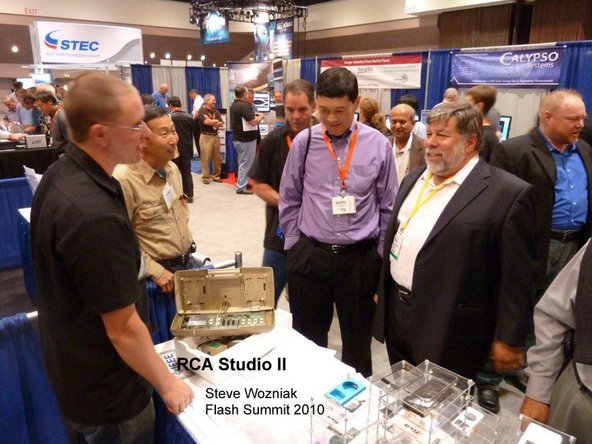
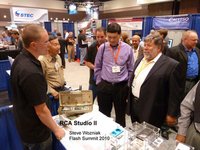
This console is quite rare given the small production number. We managed to acquire this pristine unit at Flash Summit 2010. It was on its way to the Computer History Museum but we kindly asked to "take some photographs" of it before its final resting place :)
What you need
-
-
RCA's first video game system, the Studio II, was released in 1977 with a reported retail price of $149.95 (about $525 in today's dollars), which was about $20 less than its competitors at the time.
-
The Studio II came with five games preinstalled and also had a slot for external cartridges, each one setting you back about $20 in 1977 ($70 dollars today).
-
One of the Studio II's most redeeming features is its box! Tell me you don't want that guy's red and blue striped polyester shirt.
-
-
-
The '70s vibe continues right onto the sides of the box.
-
One side of the box states that it "works on any size Color or Black & White TV." Sweet! Too bad the Studio II puts out a signal in Black & White only.
-
The five pre-programmed games stored inside the Studio II include:
-
Freeway
-
Bowling
-
Doodle
-
Addition [Really?]
-
Patterns
-
-
-
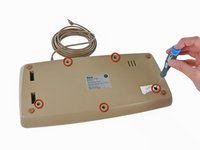
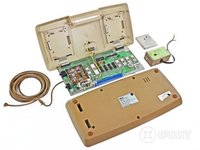
A meager five screws are all that hold the two halves of the Studio II together. That's 500% more screws than in the Odyssey 100, but half the screws required to open the top cover on a PS3 Slim.
-
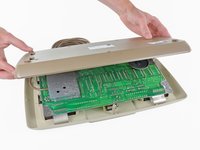
Lifting off the bottom cover reveals...
-
-
-
...A circuit board!
-
The on-board mono speaker is the sole source of the Studio II's sound effects.
-
The extremely large traces and widespread coverage of solder are characteristic of 1970s era electronics; big chips required big boards and a lack of environmental restrictions resulted in boards bathed in lead.
-
-
-
-
At the heart of the Studio II lies an RCA CDP1802 microprocessor, running at a scorching 1.78 MHz. Coupled with 2K ROM, 512 bytes RAM, and a 64 x 32 pixel monochrome graphics chip, the Studio II was underwhelming even back in 1977. To put things into perspective, the TI-83 calculator (introduced in 1996) operates at 6 MHz and has 32 KB of RAM.
-
The RCA CDP1802 was a bit of an unusual chip for its day. A version of the 1802 was manufactured by depositing a thin film of silicon on a sapphire wafer. The extremely low electrical conductivity of the sapphire wafer prevented any stray electrical current, caused by radiation bombardment, from spreading to (and possibly damaging) nearby transistors on the chip.
-
Due to their inherent radiation resistance, six RCA 1802 processors were chosen to control the Galileo spacecraft during its 14 year trek to Jupiter and its moons. They eventually burned up with the rest of Galileo when it was purposely steered into Jupiter's atmosphere in 2003.
-
-
-
The four ROM chips you see here house the (apparently) copyrighted games that came preinstalled in the Studio II.
-
Aside from the five games contained within the system, RCA released an additional nine game cartridges to bring the total count to a staggering 14 games.
-
Compare this to the 900+ games made for the Atari 2600 (and its awesome joysticks), and it's not hard to see why the Studio II was such a staggering failure.
-
-
-
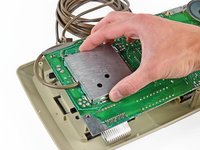
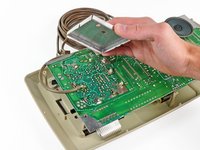
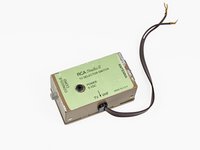
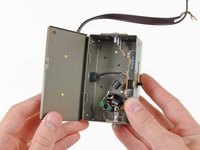
Here's a closeup of the Studio II's RF modulator. The power supply also comes in through this cable and is separated here.
-
The pattern for the traces connecting components across the board is most definitely hand-drawn. This was very common before computer-aided design programs were used to make very straight, organized traces. Most of the wide solder areas are the ground plane.
-
-
-
For a three decade old console, the RCA Studio II put up quite a fight. But in the end, defeat was imminent for the "worst video game system of all time."
-
We showed off the console to Woz the other day. He got a real kick out of it because it was designed at the same time he was designing the Apple II. Unlike the Apple II, the Studio II did not ship with circuit schematics.
-
Keep an eye on our teardown page or blog for a detailed look at another retro game console tomorrow!
-










3 Guide Comments
Seriously guys, you need to look at this console in terms of 1977. It really was pretty cool when the only other game in town was PONG.... I had PONG : (
Also knocking it because it is surface mount? Nobody was doing surface mount in 1977 except maybe for the odd single chip. All resistors, caps, diodes and transistors were hole through.
And finally to compare this unit to a 1996 TI calculator is ludicrous... 19 years in 1977 - 1996 may as well be 190 years for the rate of development in that period.
By no means is this a stellar console but rather than parrot what Wikipedia says on the subject you should have found someone who knows something about them. The electronics inside that bad boy revolutionized the electronics used in spacecraft, vehicles, cellular phones, inventory control systems and many other control systems. The 1802 chip is still manufactured (more than 35/36 years later) and might just be the most successful uProcessor created. It's worth getting some facts from an engineer maybe ; )
