Introduction
We partnered with Chipworks to bring you a teardown of the all-new Microsoft Kin Two!
The Microsoft Kin Two is the Kin One's taller brother, and is manufactured by Sharp Electronics.
What you need
-
-
-
The top of the phone features a headphone jack, while a Micro USB port can be found on the bottom.
-
The Kin Two is 19.05 mm thick. That makes for a bigger bulge in the pants, given that the thickness of the iPhone and Motorola Droid are 12.3 mm and 13.7 mm, respectively.
-
Enter "Is that a Kin Two, or are you happy to see me?" jokes here.
-
-
-
Sliding the screen upwards reveals a relatively simple keyboard. No fancy D-pad, just one "alternate" text button. Judging from the look of the keyboard, Microsoft's marketing this phone to the 12-year-old txting crowd.
-
The back side reveals the lovely 8MP camera and LED flash...
-
...And the back cover comes off to reveal several screws underneath!
-
It looks like it's pretty easy to exchange the battery in the Kin Two. Hint, hint, Apple!
-
-
-
With the two sliding halves of the phone separated, you can easily see the odd-shaped springs that keep the phone either fully open or fully closed.
-
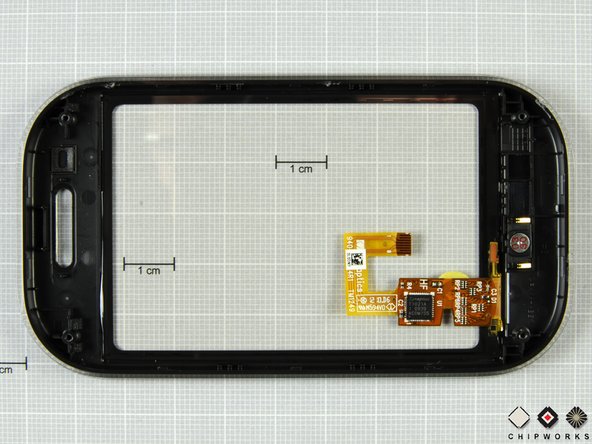
The connector highlighted in yellow is responsible for sending data between main board and the display, microphone, speaker, and touchscreen.
-
Several rows of pressure contacts help exchange data between the main board and the external buttons, microphone, speaker, and antennas embedded in the outer case.
-
-
-
The camera is the Sony IMX046, which is fabricated using a 90 nm CMOS process. The camera's resolution is 8.11 effective megapixel (8 active megapixel), 1.4 μm sized pixel, 1/3.2" optical format. Samsung was the first to use this camera in the M8800.
-
An LED flash placed next to the camera lens on the rear case sheds some light on night shots.
-
For all its pixels, the camera only eats up about .5 cm3 of space inside the Kin.
-
-
-
-
The front and back of the main board.
-
The camera is nestled quite nicely in a little cutout near the top of the board.
-
When buttons are pressed on the QWERTY keyboard, they simply bridge the connection between the gold ring and its center dot.
-
If only the steel shield supports were gone so we could view the board unobstructed...
-
-
-
The Wolfson Micro WM8903 is a low power stereo codec with all sorts of fancy features like programmable audio path control sequences, both pseudo-differential and fully-differential analog inputs, a dynamic range controller, and all sorts of other technical jibber jabber.
-
-
-
Was ist das? It's actually an Nvidia Tegra processor, buried beneath an Numonyx package seen on the surface.
-
Samsung's moviNAND chip supplies the 8GB of storage space for the Kin.
-
The moviNAND package can transfer data at speeds up to 52 MB/s.
-
The Qualcomm QSC6085 package delivers up to 1.8 Mbps reverse and 3.8 Mbps forward speed on CDMA-2000 networks.
-
-
-
The small silicon chip pictured appears to be a Texas Instruments WL1271 for WLAN and possibly Bluetooth connectivity.
-
Avago's ACFM-7103 PCS/Cellular/S-GPS Quintplexer simplifies mobile applications designed for simultaneous voice service and GPS positioning.
-
Another Avago chip, the ACPM-7353, provides dual band power amplification for cellular and PCS connectivity.
-
-
-
STMicroelectronics LIS331-DL inertial sensor (3-axis digital MEMS accelerometer).
-
Another chips near the camera connector were not readily identifiable, but they most likely help with transferring data between the camera and the main board.
-
AKM's AK8973 3-axis Electronic Compass. The same like in most mobile devices today. Placed out of the shield to feel geomagnetic field freely.
-
We'll update the teardown as we find out more. Follow @ifixit to stay up-to-date with the hardware world.
-
Thanks again to our friends at Chipworks for the photos!
-






2 Comments
I have an issue with my Kin twom. The backlight for the video is not working. I have already read Verizon forums and there isn't a solution yet that I can find, but there are a lot of users with this issue. Based on your teardown, what do you think it could be? Not sure if this post is monitored or not, but if it is, please reply.
Thank you.
