Introduction
Overview of the BlackBerry Bold hardware with circuit diagrams and labeled chips. See www.phoneWreck.com for more detailed information on the BlackBerry Bold and other devices.
What you need
-
-
Features of the blackberry bold include:
-
A 2.65" HVGA screen.
-
Stereo speakers.
-
Marvell’s Hermon Processor 624MHz.
-
Full QWERTY keyboard.
-
-
-
Here is where we get down to the nitty grittys of the device.
-
The Bold was as pleasurable to teardown as it was to review. Opening it up was simple, but the Bold gave us trouble when it let us look at its hallowed PCB. It’s a complicated mess there.
-
ICs seem to be relatively organized, but there are so many pieces to this puzzle, that it was a daunting task to build up the BOM and the block diagrams. Fortunately for you, we love doing this stuff. So we present to you, the BlackBerry Bold Block Diagram.
-
RIM spent a WHOLE TON of money on their new Samsung-made screen. It’s an expensive beast; but we’d say that it was totally worth it.
-
-
-
-
One of the questionable design choices was the integration of 802.11a. Implementing 802.11a, which is rarely used by anyone, meant that a dedicated power amp, antenna, and possibly the cause of another Wi-Fi-dedicated PMIC needed to be included.
-
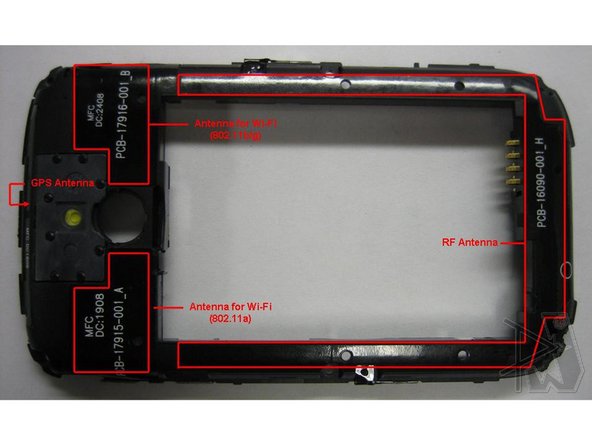
Another thing to note is its antennas. Instead of the traditional metal prongs used in most phones, RIM has used what appear to be stickers. These pretty much surround the back of the device.
-
These placements of the antennas are educated guesses, however. What seem to be obvious placements of the antennas are due to the use cases (holding the phone to your head, or cradling the phone while browsing will cover up areas of the device).
-
-
-
View the main IC diagram here.
-
Samsung continues to impress with its multi-chip packaged MoviNAND+OneNAND+Mobile DDR.
-
Infineon and Renesas got big wins with their RF transceivers.
-
SiRF also makes a big entrance with the inclusion of its GPS + A-GPS functionality.
-
Cypress also seems to have the West Bridge thing down pact producing those speedy sideloading results noted earlier.
-