Introduction
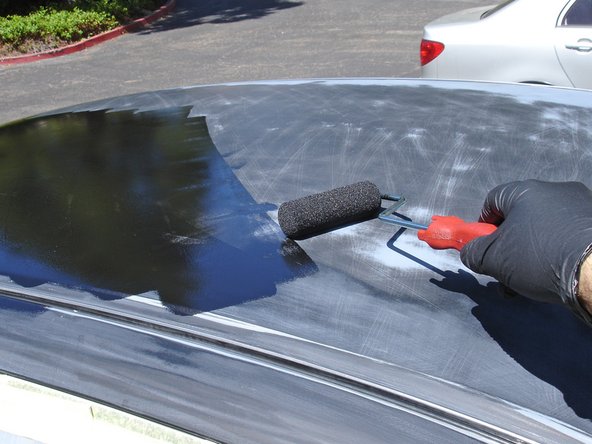
Use this guide to help you re-paint parts of your car, or your entire car. This guide covers arguably the hardest method — rolling on the paint with a roller. You can also use cans of spray paint ("rattle canning" the car), but the best results will come from an air-powered sprayer — but also at the highest cost.
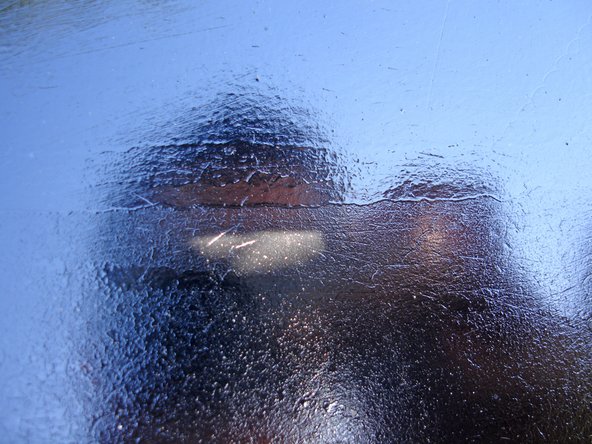
Generally speaking, a car's paint job consists of a base layer (the colorful part), and a clear coat layer on top of the base. If you were to spray paint the with an air-powered sprayer, that would be the method to pursue. However, since this guide shows how to roll on the paint, we'll be using a glossy Rustoleum Enamel paint that will serve as both base and clear coat. You'll have to roll on several thin coats of paint, but it will still technically be a "single coat" paint job.
Always work in a well ventilated area and remember to use proper safety gear when prepping the car for paint and when painting, especially respiratory safety gear. This is bound to be a long and involved project, so work slowly and carefully to have the best possible paint job possible. Also take a couple of pictures of the car before starting the job, so you can remember how terrible everything looked like prior to your new paint job :)
What you need
-
-
Use the proper safety gear when sanding. Full length clothing, a painter's mask and eye protection should be worn to prevent irritation or injury.
-
Remove all the headlights and tail lights so that the paint matches on the edges of the body. Cover any holes that you don't want to become dusty and painted.
-
-
-
Use a power sander with a low-grit sand paper to strip the old paint off the surface of your vehicle. Use a sanding block or just the sand paper to reach small or hard-to-get places.
-
Make the first pass with at least 100 grit, possibly even as low as 40 grit sandpaper. Coarser grits will remove the paint efficiently, but leave a very rough finish.
-
Make a second pass with finer sandpaper (200 grit), to reduce the scratches and smooth out the body.
-
Repeat the procedure with 400, 800, and 1500 grit sandpaper to make the car's surface super-smooth. Spend a good amount of time with each grit, as it will be much harder to remove the deep scratches down the line.
-
Wipe off the sanding dust occasionally to help speed the sanding process.
-
-
-
-
Once you have stripped the paint off all the parts that you wish to paint, rinse them with water and wipe them down with a clean lint-free cloth so the paint will stick.
-
Cover all parts of the car that you don't want to be painted using masking tape and/or double sided tape with drop cloth. This includes lights, windows, mirrors, grills, tires, the ground/any close-by surfaces, etc.
-




To reassemble your device, follow these instructions in reverse order.
To reassemble your device, follow these instructions in reverse order.
Cancel: I did not complete this guide.
29 other people completed this guide.


13 Comments
WOW I can't believe you rolled it after you did all that work to sand and mask off everything. How did it come out? You must have done a lot of 600 to smooth it all out. Do yourself a favor, go to Harbor Freight, get a spray gun and compressor. People Please don't use a brush!!! roller is much better but will leave bumps.
It worked fine for me, @%^$$@$.
If memory serves, the optimum pressure for a spray gun is about 25 psi and the optimum distance is a foot (300mm) and when doing so, you need to DIRECT spray the panel, which isn't necessarily easy with all the angles etc. For the top coat, I found using a wide fan spray to be best, which resulted in the least number of imperfections, but you need to remember, your local environment WILL affect it, a dust free spray room is obviously the best, but thats not always available
I might try this if I ever buy a cheap beater just to test it lol
